NOTE: In order to avoid overwhelming my readers with too much material at once, I will be posting the two articles by Tom and Sheila Jones in a couple of days, one at a time. This will also give you additional time to access the other materials by Michael Burns that I mention in this present article should you choose to do so (and I hope you will).
When I started this blogsite, I felt moved by God’s Spirit to do it. A few months before, I was asked to speak in the Dallas church of which I am a part, addressing racial issues. It was a time of high racial tensions in Dallas, right after a black man killed five white policemen. One of the members of our racially diverse church was a white policeman and on the Sunday after the shooting he had a small part in one of our regional services. He was still full of emotions as he shared thoughts about the “passing the plate” contribution time. Understandably, he said a few things about the recent tragedies in his law enforcement world.
Some of our black members found the courage to speak up and ask why we never heard anything publicly mentioned about unarmed black folks getting killed by white policemen. Our congregational evangelist wrote an apology email and sent it to our entire membership. He promised that we would do better to get in touch with our black members’ world – and we have. I don’t think we have done enough but I am thankful that we have done more than most churches and more is yet planned.
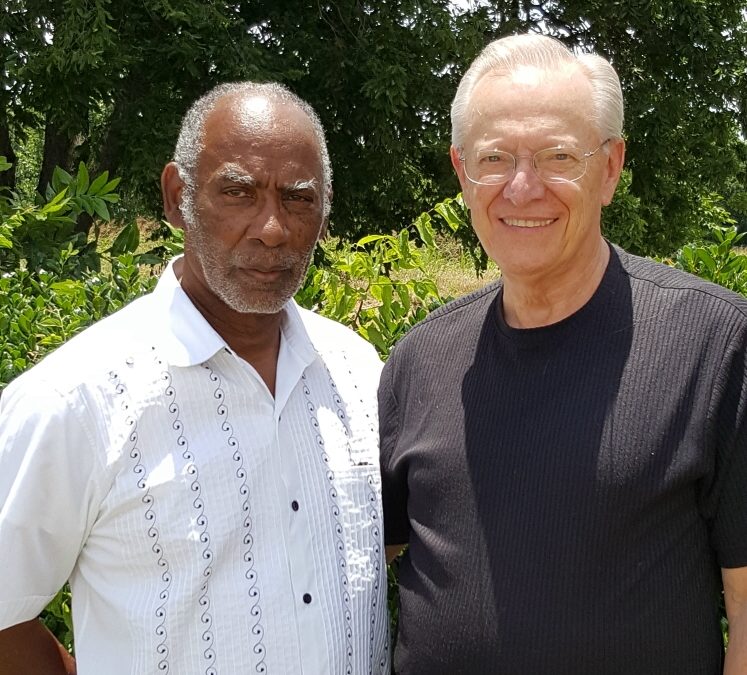
Following my sermon, the leaders of the two other main regional groups in our church asked me to deliver the same lesson I had done in our Southwest Region. After doing that, I began receiving calls from several churches outside Dallas requesting similar lessons. I don’t pretend to be an expert in the area and don’t have nearly the expertise of my good friend, Michael Burns, who speaks in our family of churches very frequently on the topic. He just recently spoke in Dallas. One of my older black friends in the church (pictured above with me) remarked after Michael preached that of all the sermons he had ever heard, Michael’s lessons would rank in the top five. I had much the same feeling. You can listen to these lessons on the dfwchurch.org website and also read other articles by Michael and watch his “Crossing the Line” video series on Disciples Today (disciplestoday.org).
One thing I do bring to the table in speaking about racial issues is that I am white, male, old and southern. That gives me a perspective about what racism looked like during the Jim Crow days, but only as an observer. Thankfully, during my teen years it was as a pained observer. I wasn’t one of those outwardly fighting against those of a different color. My parents were not racist in the same way that many of our friends and relatives were, a fact for which I am eternally grateful. But we were racist in unconscious ways. We were ignorant of the true plight of half of the population of our own city. We were comfortable with the status quo. We didn’t question the way things were. We did nothing to try and change the system as it functioned.
If I were suddenly thrust back into those days via a time machine, knowing what I know now and feeling what I now feel, I’m pretty sure my convictions would have led me an early death. But I can’t go back and do it differently, nor can you. We can, and we should, and we must do things very differently now. And that is the reason this blogsite was begun. As I often put it, I want to help my white brothers and sisters understand the world in which our black brothers and sisters live every day of their lives. I also want to help my black brothers and sisters deal with the injustices, prejudices and racism (overt and covert) that are a part of their world. If we claim to be disciples of Jesus, we must imitate him and how he dealt with those kinds of mistreatment in his life. The world is the world is the world – and it always will be without Jesus. Those of us who have Jesus, regardless of our skin color and culture, must embrace the new world the Bible calls the kingdom of God and live by its principles.
Tom and Sheila Jones
Since I do not profess to be an expert on racial issues, I post blogs written by others, Michael Burns being the most consistent contributor. The next two posts are written by a couple who happen to be among our nearest and dearest friends – Tom and Sheila Jones. They once headed up Discipleship Publications International (DPI), for years the publishing arm of our family of churches. They are quite simply, exceptional people and exceptional disciples of Jesus. Like me, they are old (although a few years younger than me), white, and southern.
What they have written will be included in an upcoming book by Tom, which he mentions in the introduction of their articles. They write about their journeys in life as it relates to race. They have been members of racially diverse churches for decades, so having black friends is nothing new for them. However, in very unique and extremely vulnerable ways, they each addressed their segregated childhoods and young adulthoods. I wept again and again as I read what they wrote. I also thought of the above title for this present article. As they poured out their hearts and their experiences, the process of Carthesis was taking place. I have admitted more than once in some of my previous blog articles that I was writing to get in touch with my own soul and bare it before God and others about this thing we call race.
But along with Tom and Sheila, we hope and pray that our examples encourage others to search their own hearts – deeply. We all need Carthesis, increased awareness and repentance in many areas, certainly in the racial realm. When I say “we,” I mean all of us, black, white and brown. We all have our prejudices whether we see them clearly or not at all. Heart-checks are an ongoing, essential part of being a Christian. I beg you to read what Tom and Sheila have written as they have poured out their souls. I promise you that you will be very grateful and very humbled. They are among my greatest heroes on earth. Read and see why. Please!

The following material will appear in The Kingdom of God, Volume Three: Learning War No More by Tom A. Jones to be released later this year. The book will be available from Illumination Publishers.
As we open this chapter and the one to follow, I want to depart from the norm and ask you, my reader, to think of me as Alabama Tom Jones. I owe that idea to a blues musician from the 1920s and 1930s named Mississippi John Hurt, but we will come to John later and how he came to influence my life. Just now, let me tell you a story with some twists and turns to help you understand the reason for my new moniker and how it relates to understanding race and racial relations through Kingdom eyes.
I was born in the town of Florence and received my college degree in the same town twenty-one years later. In between those two dates I spent almost all my pre-college years in the adjoining town of Sheffield and worked some years in a third bordering town of Tuscumbia. To round it all out, most of my Sunday mornings were spent going to church in Muscle Shoals, the fourth connected town, and the home of a famous recording studio. These “Quad-Cities” in the “Shoals Area” were all in the northwest corner of the state of Alabama.
I have complicated feelings about my home state. I have not talked much publicly or written about this, but it seems it is time that I did. It was there fifty-one years ago on the campus known today as the University of North Alabama that I first counted the cost and made the decision that Jesus would be to be the Lord of my life. It was also there that I soon began dating the one who would share these last 50 years with me. For both of these, I am most grateful. While, my wife, Sheila, would not mess with my relationship with Alabama, Jesus certainly did.
Feeling Fine in Alabama
Prior to becoming a disciple of his, I felt quite fine about being from Alabama. More than that, I felt quite proud of it, in a rebellious kind of way. In the alphabetical list of states, we were always at the top, always first to vote at the nominating conventions. And, maybe most important to me, for more than two decades of my life, we had Bear Bryant, and were often in top five in the nation in football and number 1 more often than anyone else. In 1959, the man on his way to legendary status heard the call to “come home to Mama,” and returned from Texas A&M to his alma mater, and started one of the greatest runs of championship football in American history with the Alabama Crimson Tide. Like a lot of other Alabamians (except those for Auburn), I felt he had taken me personally along for the ride.
On Saturdays I made my way to the football shrines in Tuscaloosa and Birmingham as often as possible and watched the revered coach in his houndstooth hat prowl the sidelines and lead his team. Only much later would realize I was so connected with “The Bear,” that he was almost like a second father to me. No doubt there were thousands of other Alabama boys who felt the same. Years after his death I watched a documentary on his life and found myself unexpectedly weeping – a very rare experience for me, but one revealing how deeply he had become part of me.
Besides the Bear and the Crimson Tide, I was also proud in the 1960s that we finally had a Southern politician standing up to the big shots in Washington. He was working toward a third-party run for president. He drew major media attention and would win enough electoral votes to nearly throw the election into the House of Representatives. We cheered as he appeared on “Meet the Press” and proudly stood for conservative values and “states’ rights.” He looked at Democrats and Republicans and said “There is not a dime’s worth of difference in them.” He spoke to the common man (or really the common white man). My dad said, “Son, he gets the hay down where the goats can get it.” We loved it. We loved him. His name was George C. Wallace (Yes, the same one who proclaimed “Segregation now, segregation tomorrow, segregation forever!”)
So, my worldview was pretty simple and Alabama fit very well in it. I have a memory of being on a team bus and passing a baseball field when I was in high school. I can still see the sign on the center-field fence. It said “American Legion: For God and for Country.” That summed up life in Alabama. We prayed at Scout meetings. We had Bible reading to start school days. We prayed before Friday night football games; we sang the national anthem there and did both again at the college games on Saturdays; we went to church on Sundays; we supported our troops in Viet Nam. We were the good guys: for God and for Country. It all blended together. Never mind that we were racists and white supremacists who would, at the same time, have been greatly offended to be called that. That was me. That is where I was.
The Kingdom Breaking In
But when the Kingdom breaks in, it upsets a lot of apple carts, and, predictably, Jesus started troubling my nice little world. Not long after committing myself “totally” to him as best I understood that, I found myself on a shooting range with my R.O.T.C class, a mandatory requirement at my “gung ho” public college. I don’t know how many times I pulled the trigger of the World War II era M-1 rifle. I do remember two things about the experience. The gun had a kick much greater than expected, and I went back to my Bible and spent time thinking that I could not see Jesus doing what I had just done: practicing to shoot another human being. I had “played army” with my little buddies in the Alabama woods all through my childhood. I had dug fox holes with my guys. We had reveled in the many fictional TV shows based on World War II events. We had killed many a German and countless “Japs.” Soldiers were my heroes. But now I was re-examining my life through the eyes of Jesus and he was changing me. If I was following him, how could I possibly kill another human when I could never imagine him ever doing that?
Following Jesus was reshaping my thinking, but with more transformation needed, he soon moved into another space in December 1968 and challenged other long-held assumptions.
- It was a Friday night, as I recall, just five days before the new year. I was in an audience of 1,000 people, mostly college students from around the country, who had come to Dallas, Texas, for the four-day International Campus Evangelism Seminar.[1] It was a huge out-of-the-box experience for me.
- First time for a church event in a hotel.
- First time to ever be with a thousand people who weren’t watching sports.
- First time to spend four straight days focusing just on Jesus and his mission.
- First time to begin to grasp how the Holy Spirit fills the Christian.
- And… the first time to come face to face with my racist heart.
The speaker that night was a black minister and attorney from Atlanta, Georgia, named Andrew Hairston. I had never heard of him before that day, but I will never forget his message. His words would eventually change my worldview, my perspective and my life. He was the first man I ever heard in my family of churches apply the message of the gospel to racial attitudes, racial divisions, and racial discrimination. Of course, Martin Luther King, Jr., and others had been doing that for years, but I wasn’t listening. According to my white Alabama culture, King and his associates were just puppets of the Communist Party.
As Andrew Hairston spoke, he carefully did an exposition of scripture after scripture, showing that racial discrimination or bias has no place in the life of a disciple. But then, as they would say in the South at that time, “He stopped preaching and went to meddling.” He described America’s fascination with George Wallace and particularly talked about how many Christians supported him. He focused in on the racism that had been at heart of the Wallace message for years. My discomfort level was on the rise as I was learning much more about what it means to be convicted by the proclamation of the message. Often such conviction is accompanied by confusion and such was the case for me. My heart was beating fast and my mind was spinning.
After he finished, I remember some of my fellow Alabamians were angry. How dare he call out our governor? How wrong it was to bring up politics in a conference on evangelism. I, on the other hand, remember being deeply troubled. Later I would see it as almost a Damascus Road experience.
Not six weeks earlier I had cast my first (and what would be my last) vote for U.S. President in 1968 for, yes, Governor George C. Wallace of Alabama. Had that been a terrible mistake? Was I supporting something quite contrary to Jesus and his Kingdom? Had I heard only what I wanted to hear and ignored the racism and white supremacy that had long been a part of the governor’s message and his appeal? But maybe I didn’t ignore it. Maybe I subtly bought into it and rationalized it. But Jesus, through Andrew Hairston, was working on me and that is what I had signed up for. I did not fight it. I wanted the transformation he brings, if sometimes reluctantly and fearfully.
An Unsettling Connection
Returning to Alabama from the Dallas event, my story took an interesting turn. My involvement in our campus Christian fellowship had led to me becoming the president of the group. It was now several months after George Wallace’s presidential run and a wave of “decency rallies” were being held around the country. One of the largest was in Miami where they drew 35,000 teens to say “no” to the antics and language of rock musicians like Jim Morrison and the Doors.
The city of Florence, Alabama, in coordination with the university, decided to sponsor one of these rallies for decency with, yes… George Wallace as the keynote speaker. Somehow, ironically it seems now, my name was picked out of the leaders of various campus religious groups, and I was invited to share the dais with the governor and offer the opening prayer before his message. In Braly Stadium (later on and for 17 years, the annual site of Division II National Championship football games.) There were probably six to eight thousand people there. I prayed. The governor spoke. Then, the two of us talked briefly with each other after the event concluded. To this day that was likely my biggest brush with fame, or infamy.
I am not sure I would have known the word then, but looking back ambivalence reigned in my soul. On the one hand, I wanted to represent Jesus and my campus group. I wanted to be a part of an effort to say that sex, drugs and some of the vulgarity making its way into rock and roll were not the answers for our generation. I wanted to stand up. On the other hand, Andrew Hairston’s exposition of scripture would not let go of me. That day Wallace, as I recall, stuck to his decency theme and stayed away from what people today call the racial “dog whistles,” but I could have completely missed those. This is I do remember: I had a good deal of uncomfortableness and angst (though I didn’t know that word then, either) about the whole experience.[2]
As time went on, I listened to the recording of Hairston’s Dallas speech and dug into the Scriptures. I came to new convictions about all kinds of matters to do with race and the Kingdom of God. I came to very much regret the vote I cast in the ’68 election and vowed to study the whole matter of voting and government involvement more deeply before I would again mark a ballot. But, more importantly, I came to the conviction that I must speak out. A year later in Memphis, Tennessee, as a theology graduate student and part-time campus minister, that opportunity would come, and speaking out would cost me my ministry job.
With all this, my relationship with my home state was becoming very complicated. Was I still thankful for my family? Sure. Was I still grateful for what God was doing even in Alabama? Absolutely. But was I getting my eyes opened? For sure. Was I getting a new view of defending my country? Indeed I was. Was I starting to see American history, racial relations, prejudice, and discrimination in a differently light? You know it. Was I proud of Alabama? No, actually that was slipping away. Was I starting to be embarrassed about being from my state? Yeah, that was becoming more and more true. And I was ashamed that I could have been so blind as to not see some things that should have been so obvious. Later on, of course, I would know this is just a part of maturing. But God was working on me. He still is. I have not arrived.
Why Alabama Tom?
All of this brings me to what caused me to do something that shocked even me, and that is decide I want you to know me as Alabama Tom Jones. After spending five decades trying to distance myself from my roots—from white supremacy, from Jim Crow, from lynching, from the Klan, from Governor Wallace, from blocking the school house door—I have decided for a number of reasons to put myself and my state in the same moniker… out there for all the world to see. And it is not because I think my state is now wonderful. No, it still has huge problems. Alabama may have as many politicians in jail as Illinois or Rhode Island. The governor in office as I write, stepped in when the former governor, and Baptist Sunday School teacher, resigned in the midst of a sex scandal. The previous Speaker of the Alabama House is serving a four-year prison term. It is not because my state still has a good football team and often has two. No, as I have grown older, that is not something I feel so proud about. I decided two years ago to not watch any football games that season. For that year I saw no football, college or pro, and didn’t see Bama win the National Championship on the last play of the game. But that is another story for another day.
So why would I attach my state to my name? Why make a big deal out of where I am from? I never have. Why now? Let me give you my reasons. But I am not guaranteeing they will make sense. This is a real “feeling” thing.
Reason #1
First, at this time in American history we are revisiting some of the ugliest parts of our past. We are still trying to come to grips with what Alabamian and former Secretary of State, Condelezza Rice, has called our nation’s birth defect, referring, of course, to slavery. Others have called it America’s original sin. We are more than 150 years removed from the end of the Civil War, but we deal everyday with issues from that time, and that is true both without and within the Body of Christ.
Racial relations have been worse in the past than now, or maybe we should say white people have treated black and brown people worse in the past. It does seem that we have made progress. Especially in some places in the church, it is a different world from the 1950s and 1960s, but underneath, there are still things hurting some people (of color) while others (who are white) are completely out of touch with that pain, and often out of touch with their own biases. There are still huge lessons to learn.
I have just recently been in meetings with faithful disciples where there were various painful racial overtones, poor word choices, judgments and misjudgments coming from our failure to understand each other or to deal with matters of the heart. Lesson learned: We have miles to go before we sleep. We are not yet healthy. Now is a time to speak. Alabama is, arguably, ground zero when it comes to racial tension and division and bad practices. If I am ever going to be Alabama Tom Jones, and face my past, it should be now. People like me need to be addressing these issues, sharing where we have come from and what Kingdom teaching has to say.
Reason #2
Second, none of us should try to hide our roots. I have made that mistake. Not a one of us had one word to say about where we were born or what color our skin would be. We did not get to pick the family we were in as children, or the city or the state or the country. People made fun of where Jesus was from, but there is no indication he was ashamed of his home or his origins. That didn’t mean he thought they were all just fine. He challenged them, even as he brought the fulfillment of the Kingdom right into their midst (Luke 4). They ultimately rejected him, but since we know he later wept over the same response in Jerusalem, he surely felt deeply for his own hometown and nowhere tried to distance himself from them. What I see is that we need to let the seeds of Kingdom love, redemption and transformation grow in the soil of our culture and experiences whatever they have been like. Our roots may be renowned or lowly, but we can be sure that no background was better than another in light of the Kingdom. All fall short. Wherever we came from, we all need redemption and transformation.
However, while we should not hide our roots, we should expose the darkness wherever it is found. I am deeply sorry about a lot of things that happened in Alabama. I am sorry for the horrible history of slavery that was in my state and many others. I am sorry for all the lives taken and the lives lost defending it. I am sorry for the awful years of white terrorism, lynching, Jim Crow laws, segregation and discrimination. I hate that it happened. I hate that I didn’t just hear about this. I lived through much of it and didn’t think anything about the suffering of African-Americans. I am sorry that I didn’t get to know them and that I joined the crowds in treating them like something less than we were.
I hate that four precious little girls were killed while attending Sunday School. The explosion at the 16th Street Baptist Church was caused by fifteen sticks of dynamite planted by Klansmen. I hate that men of my state committed that act of terrorism and brutality against other people of my state because they were a different color. It happened 125 miles from my home in a city I went to often. This violence against those girls happened only 1.6 miles from the stadium where I shouted “Roll Tide” on Saturdays. I am deeply sorry that for me and my family, it didn’t seem to matter. I recently checked it out: Those little girls died six days before my sixteenth birthday and probably all I was thinking about was getting my driver’s license the next week. I was a nice church-going boy completely absorbed in his own little world, and I am very sorry.
I am sorry for the firehoses and the dogs and that the Letter from the Birmingham Jail had to be written. I wish I could erase it all. I have had, and still have to, deal with white guilt. And it is not just because “my people” did that kind of thing, but that I was so out of touch and so complicit. I need to admit I was Alabama Tom Jones.
In the early 1960s while Birmingham was a place of pain and struggle for black Alabamians, it was for me the place where national championships were won (by all-white teams, by the way). I gloried in the latter and didn’t give any thought to the former. It would be more than thirty years later I would even know it was called “Bombingham.”
But I have learned that I can look back on the history of “my people” and I can condemn what they did, and what I did, without trying to hide where I am from. Wherever in the wide world you were born and grew up, bad things went on. Racial bias may have been institutionalized and weaponized in Nazi Germany, the American South and in South Africa, but you can be sure it exists everywhere. And if it doesn’t, you will certainly find other evils that are just as bad. Anne Lamont writes that a friend of hers says, “There are three things I cannot change: The past, the truth, and you.” While we cannot change the past or where we are from, we can certainly face the truth about it, learn and move forward in a better way. The point is not for us to be ashamed of our roots, but to show that we take the good we found there and, by the grace of God, overcome the evil we found there, letting the light into our souls right in those places or right in us wherever we have ended up.
Reason #3
That leads to the third reason I have decided to be Alabama Tom Jones. I want you to hear from at least some people from my state that the message of Jesus Christ can change even those of us from Alabama. They said about Jesus, “Can anything good come out of Nazareth?” I know people feel that way about Alabama. Hey, I sometimes feel that way myself. An editorial about my home state in the New York Times was published while I was first working on this. It was not complementary. It didn’t exactly ask, “Can anything good come out of that place?” but it made you wonder. (By the way, just so you know, I am not a New York Times basher.)
One day I started thinking that except for football glory and some things in the music scene, white people from Alabama don’t have a very inspiring history. We never had a Washington nor a Lincoln nor an Andrew Jackson (but he’s a mixed bag even though he’s on the twenty dollar bill.) Were it not for Helen Keller (from Tuscumbia, by the way) and a pretty long list of African-Americans, the state would not have a lot to celebrate. Thankfully, there are Booker T. Washington, George Washington Carver, Rosa Parks, Fred Shuutlesworth, Jesse Owens, Henry Aaron, Willie Mays and Condeleeza Rice. My Auburn friends would likely add Bo Jackson or maybe even Sir Charles (Barkley).
So, I looked at that and I thought maybe it is not too late to become Alabama Tom Jones. Maybe a white guy from Alabama could still inspire. But watch out, I told myself, because this is tricky. You could be on dangerous ground. Your motives had better be pure. You must not want this for personal glory. It must be because you want it known that the grace of God can reach even a self-righteous white Southerner, born and raised in the Heart of Dixie in white privilege (privilege he didn’t know for so long that he had) and believing in racial superiority. You must do it to point to the Jesus who opened your eyes to the evils of racism, white supremacy and bigotry that were in your own heart, and then, forgave you of all that and helped you catch a whole new vision of brotherhood in the new humanity he created. You must do it to show that through Jesus, something transformed can come out of Alabama…or Mississippi…or South Boston…or Germany…or South Africa.
You see, if I hide my Alabama roots you may never see that. And honestly if I am not transparent in this way, I myself may never see what a miracle God has performed. I may deceive myself into thinking I am some self-made man who extricated himself from a distorted view and now lives in a realm above my old Alabama neighbors.
Enter Mississippi John Hurt
Back some months ago I watched a documentary on PBS entitled “American Epic” that was about the birth of musical genres in the United States. It was in this program that I was introduced to the man known as Mississippi John Hurt. Quite unexpectedly I found myself being deeply touched by his story and persona.
John was a black man born in the tiny spot called Teoc and raised a few miles away in Avalon, Mississippi, another place you may not be able to find on a map today. He taught himself to play the guitar around age eight. As he worked as a sharecropper, he played music at dances and parties.
At age 36, John was living alone in his little three-room cabin, when he was discovered in 1928 by a record agent who led him to Memphis where his first recordings were made for Okeh Records. After the record was made, the company sent him a copy. but he had nothing to play it on. He took it to the white lady he worked for and asked if she had a Victrola. She cranked it up and let him stand outside the screen door and listen while she played his single.
The record was a good seller. Soon he would be asked to go to New York City for another recording session featuring one of his best tunes, “Candy Man.” Feeling lost and homesick while in the city, John wrote “Avalon Blues” which became another hit. His road to fame, however, was quickly interrupted by the onset of the Great Depression. Nothing more came of his efforts, at least for the next 35 years.
Until 1963, he lived back in obscurity in Avalon, minding someone else’s cows. He gave up the guitar. His music stopped. But then more than three decades after his first record, a blues enthusiast named Dick Spottswood searched to see if Mississippi John was still alive. He found him, still in his little house in Avalon. Spottswood loaned him a guitar and the magic came back.
Soon he had booked John as a last-minute replacement at the ’63 edition of the Newport Folk Festival. He hadn’t picked up a guitar in years, but at age 71, he began a three-year revival of his musical career that resulted in the recording of several albums. At age 74, he died in Grenada, Mississippi, 21 miles from Avalon. You can find his music on YouTube and his songs have been recorded by the likes of Bob Dylan, Jerry Garcia, Beck, Doc Watson, Taj Mahal, Bill Morrissey, Gillian Welch, Josh Ritter, and many others. Great blues artist Taj Mahal said, “John Hurt was like a man with the key to the musical universe.”
Why was I so moved by Mississippi John Hurt? Maybe it was his kind face and the humility and contentment he seemed to exude. Maybe it was the story of an amazing talent that only shined for five or six years in two different eras, but had great impact. Maybe it was the fact that John was a poor black man who touched the world, when he was the kind of person that I and my family would have avoided. Maybe it is because I’m 71 and Mississippi John was rediscovered and practically “reborn” at 71. Maybe it had something to do with the fact that the name of another place that doesn’t get good press was connected to an inspiring account. (I doubt I will ever again think of Mississippi without thinking of John Hurt. “Mississippi John” has replaced “Mississippi Burning.”).
And then, maybe it was the converging of all these things.
Who knows all the ways God’s Spirit works in us and on us? But this I know: Without Mississippi John Hurt, I don’t think I would have ever thought of being Alabama Tom Jones. Since going there has been very good for me, Mississippi John, I thank you. While I will never inspire others with my song writing or with great finger picking or with a smooth voice like you had, I am different because of you. You have helped me embrace my roots in a redemptive way. I don’t know much about your faith. I see you did a 78-rpm with “Blessed Be the Name” on one side and “Praying on the Old Camp Ground” on the other. However, I know God has used you to take me to some new places.
A Broad Redemption Indeed
I now know that I can give people of my state—both black and white—this word:
Whatever gifts you have or don’t have, because of Jesus, your heritage, your roots and even your religion can be redeemed. Because of a surrender to him, you can see the world in a different way and you can inspire others in ways you would hardly believe. I can be an Alabama Tom and you can be an Alabama Michael or Alabama Charlotte or an Alabama Desi. And in the process just maybe we can inspire others to be a New York Vincent or a Kansas Leslie, (although it won’t have the lyrical quality and charm of a Southern state!).
I hope you don’t misunderstand, but since this is such a “feeling” thing, you very well might. What you have read so far in this book and what you will read in the rest are not the words of a man once again proud to be a Southerner. They are the thoughts of a man, born white in Alabama, who was given the grace to see how much he needed grace. I write about the Kingdom of God not because I have it all figured out, but because the one who reigns in it has us all figured out and still loves us and draws us into it. Our heritage, our race, our roots, our politics, our religion, they can all deceive us and mislead us. But the prayer, “Your kingdom come; your will be done…” can guide us and lead us and transform our view of all those things and even make good use of them.
Not long ago, and I mean not long ago at all, I would have cringed at the idea of printing “Alabama Tom Jones” on anything. Now I have an overwhelming sense of not deserving to be Alabama Tom Jones. I am not sure you will understand that. I’m not even sure that I do. But, as I have moved into my seventies, I am more aware than I have ever been that I was lost and I now I am found. More than ever, I appreciate the words of another flawed Alabamian:
“Just like a blind man I wandered along
Worries and fears I claimed for my own
Then like the blind man that God gave back his sight
Praise the Lord – I saw the light.[3]
Jesus had a place-connected name. Today we gladly call him Jesus of Nazareth. Nazareth Jesus. So…Alabama Tom. Tennessee Reese. Florida Jeanie. Colombia Flavio. Louisiana Gordon. Wisconsin Clayton. Atlanta Steve. North Carolina Wyndham. Congo Titus. You get the idea.
All that we have been can be infused with all we can still be, and the transformation can be glorious. But it’s best if we tell the whole story from beginning to end. And for me that means being Alabama Tom Jones.
[1] I have written more extensively about the significance of this conference in my book In Search of a City: An Autobiographical Look at a Remarkable but Controversial Movement, pp. 17-21. This is now available also from Illumination Publishers at ipibooks.com.
[2] I must note a change in George Wallace’s life that is little known, or at least, seldom reported. After another presidential run, when Wallace had been paralyzed by an attempted assassination during the campaign he publicly apologized for his racism in a black church and asked forgiveness. It seems that playing a major role in his repentance was the compassion shown to him by New York’s Shirley Chisholm, the first black woman to ever run for president. Chisholm, who was running at the same time as Wallace, rejected the advice of her staff, suspended her campaign on the West coast and flew across the country to visit Wallace in the hospital. He was shocked and moved. Ten years later, after being out of office for six years, Wallace sought a fourth term as Alabama’s governor. The man once reviled in the black community, won a new term as governor, largely because he received 90% of the black vote. Thirty-seven years later, the May 16, 2019, edition of the Washington Post called George Wallace “a model for racial reconciliation.” https://www.washingtonpost.com/opinions/2019/05/16/changed-minds-reconciliation-voices-movement-episode/?utm_term=.9fc6512639d1.
[3] From “I Saw the Light” by Hank Williams, written in Montgomery, Alabama, in 1947, the year of my birth. Not popular at first, this song would go on to become an American standard.

April, 1994
The following piece will also appear as an appendix in The Kingdom of God, Volume Three: Learning War No More by Tom A. Jones. Sheila wrote this 25 ago when she and Tom lived in Concord, Massachusetts. At the time, she wanted to submit it to the local paper back in their hometown in Alabama, but Tom’s parents asked her not to. They feared it will just arouse resentments. The Concord Journal in Massachusetts liked it, but asked her to condense it into a much shorter piece, but she could never see how that could be done. After Tom wrote his chapter as Alabama Tom, he and Sheila got this out, reread it and decided it should, too, should be included in his new book.
She grew up across town. The same town, but a very different town. She was only three years older than I, but we had never met.
You see, she was black and I was white. In our small southern town, we did not know kids of the other race.
Shirley Thompson was her name. We walked the same downtown streets, but she could not sit at the counter and order an ice cream soda at the corner drugstore. She and her friends did not have the opportunity to complain about the Cokes that were too sweet and too syrupy as my friends and I did.
They were not allowed to sit in a booth at Walgreens and eat the fresh, hot rolls made by Exxie, the black cook whose secret roll recipe enticed white patrons to return again and again. Blacks were barred entrance by the sign posted in the front window: WE RESERVE THE RIGHT TO REFUSE SERVICE TO ANYONE.
We shopped at the same stores. Like Belk-Hudson. The water fountains were on the second floor—neatly labeled COLORED and WHITE. I don’t know what we whites thought would happen if we drank from the colored fountain—we simply would not have. Our prejudiced society prompted us to watch out for each other: “Don’t drink from that one! It’s for coloreds.”
The blacks had their own theater in their section of town—Baptist Bottom, it was named for the marshy area under the Tennessee river. If they attended the Colbert Theater in downtown Sheffield, they paid the person in the designated colored booth and ascended the steep stairs to the one-third of the balcony allotted to them.
Once I went to the movie with a friend, along with her black maid and nanny, Li’l Ellen. Of course, she could not come with us to the white section—most of the theater. So we went with her. We paid at the colored booth, climbed the stairs, and sat with the blacks on their side of the high wall—the wall separating the two races from each other.
Of course, at that point in history, the whites did not fear a call for equal rights from the blacks. They simply feared the unknown. They feared giving up their prejudices and relating to people who were just like themselves. They feared believing that was true.
How painful to relive those times. We whites did not even think to question the racism and injustice of it all. Just as we did not question our eye color or our birth date.
Since I didn’t know Shirley while we were growing up in Sheffield, let me tell you how we did get become acquainted…
The Birth of an Idea
Sitting in my home in suburban Boston, Massachusetts, I am a long way from that little town and from those painstaking attempts to “protect” the whites and to confine the blacks. While reminiscing about my childhood one day, I became acutely aware that other kids grew up in Sheffield the same time we white kids did. I got the idea that I wanted to meet someone who graduated from Sterling High, the all-black school, around the same time I graduated from Sheffield High. I wanted to talk to a person who had a different view of living in our northwest Alabama town, a person who was black and who lived in a part of town that was only three miles away from my home, and yet so far away.
After making several calls to school personnel in Sheffield, I was given the name of Shirley Thompson. She was instrumental in arranging reunions for the former students of Sterling High, so she seemed a likely candidate to answer some of my questions.
I entered the number given to me, wondering exactly how I would explain the reason for my call. How would Shirley respond? Would she be offended in any way? She answered with a friendly “Hello,” and I began to explain why and how I had gotten her number. I’m sure she must have been a little thrown off, but she responded graciously to my quest and request. We talked about our different perspectives on growing up in Sheffield and agreed to have lunch the next time I came to Alabama.
That time was April 19, 1994—one day after I became 46 years old. Twenty-eight years after I had graduated from the segregated high school on the other side of town from Shirley’s school. I knocked on the door, eager to meet Shirley in person. An attractive woman with warm eyes and an engaging smile invited me in. After we talked and became better acquainted with each other, she confessed, “You know, I was surprised when I opened the door and saw that you were white. Somehow I had thought that you were black and had grown up in a white family.” Because of her past experiences, I think it never occurred to her that a white person would be searching out this missing piece of her childhood history.
We sat on the couch as Shirley showed me the keepsake book for Sterling High for the year of 1950, two years after I was born. For whatever reason, that was the only book she had available. Sterling did not have a yearbook like Sheffield’s, but every few years they produced a type of keepsake book like the one she was showing me. Especially meaningful was the picture of her favorite teacher, Mrs. Lewis, who was teaching thirteen years before Shirley graduated from high school.
Real People, Real Names, Real Feelings
Somehow it warmed my heart to see the picture of the cheerleaders. Their names were listed underneath. They were no longer just distant people who encouraged the football team as it played in the Sheffield High stadium when the whites were not using it. They were real people with real names and real feelings—just like all the other teenagers in Sheffield, Alabama, in 1950. As I looked at the picture, though I was only two years old when it was taken, I felt a connection to the past that had eluded me until now. I felt a connection to the cheerleaders who would have been cheering in 1966 when I graduated from high school.
We talked. We mused. I shook my head in disbelief and embarrassment as I recalled the inequities of segregation. As we talked, she smiled—a beautiful smile. A smile made strong and confident by years of struggle and survival—and by years of success.
Meet Reverend Stewart
To give me a better understanding of her high school, she offered to take me to meet Reverend Stewart, who was once principal of Sterling High. The building is long since gone, as the town of Sheffield was integrated years ago. On the block where it once offered betterment, not only to black teenagers but to veterans seeking the education that had long evaded them, now stand several homes with well-manicured lawns.
Reverend Stewart lives in one of those houses. Out back of his home, in a small storage building painted purple and gold, he displays and stores memorabilia from the school—snatched as the wrecking crews were poised and ready to raze. Pictures of graduating classes. Faces. Names. Some my age, but never known by me or my friends.
Reverend Stewart, a kind man in his early 80s, was happy to give us a peek at his treasures. He asked our indulgence to brag about the Sterling High chorus – “the best around.” We allowed that indulgence and were easily convinced by his accolades. Students wore hand-me-down robes from Sheffield High. But they sang their hearts out—because robes do not make the chorus. The heart and the talent do.
Shirley told me more about her favorite teacher, Mrs. Lewis. In the tenth grade, she had called Shirley to do better than C work…and she did, graduating from high school with As and Bs. Being believed in is a powerful impetus. She was part of the 1963 class of 23 students.
Because of her mother and her special teacher, she was a driver. Her mom taught her always to have a skill to fall back on—you never knew what life would bring you. A skill she learned, and she learned well. A talented pianist, she plays regularly for the Missionary Baptist Church in her neighborhood. But, two courses away from a Masters in Business, Shirley does not have to fall back on her piano playing.
A Determined Mother
While we had been at her house, Shirley had motioned to the bedroom, telling me about her mother, Velma. Day after day she lies in bed. She does not speak. She stares and sleeps and eats. She has Alzheimer’s Disease. But she is a hero. As we drove to eat lunch, Shirley told me more about Velma. She was a mother who was once strong and full of stamina, able to stretch a dollar to Birmingham and back; a mother who did housework for different white women in town, bringing home $2.50 to $3.50 per day; a mother who always fed her family—food given by an employer, chickens from the yard, rabbits shot by her husband in the dead of winter, and fresh or canned vegetables from her garden. No matter what, they always ate.
Shirley told me of a determined mother, one who had decided that her children would go beyond her tenth-grade education. Somehow, some way, with her incredibly low salary, she even bought each of her graduating seniors a car. She wanted to set them up for success in every way, although material success was less important to her than moral and spiritual success. A committed mother. A tireless mother. A mother who is cared for with the same type of enduring love she has given to her daughter through the years.
Building a New Bridge
I appreciated so much Shirley’s willingness to tell me about her life. Although I know that some of what she shared was painful, I did not sense bitterness about the past. Instead, I sensed a confidence and gratitude about the present and the future.
We entered the restaurant and were seated in a booth. We could have together complained about the syrupy cokes, but she drank water and my Coke was just fine. We each had croissants, but they weren’t as good as Exxie’s rolls, thirty years ago at Walgreen’s. A black woman and a white woman, sitting together in a restaurant in the South—the way it should be. The way it should have been a long time ago. We shared more from our lives: our kids, our hopes, our faith, our hearts. Her mother is in the final stages of Alzheimer’s. I buried a father who died of Alzheimer’s.
Yes, we grew up a few miles apart in the same town—at least in the Rand McNally Atlas. In reality—a very different town. But Shirley and I are not very different people. We are people who connected and people who are now friends. A bridge was built from north Sheffield to south, over the railroad tracks. A bridge untimely built, but built nonetheless. And bridges are for crossing.
In Sheffield the kids go to school together now – black and white. Belk-Hudson is closed, and the separate water fountains have long since rusted in a junk yard. Blacks and whites sit wherever they want in restaurants and in theaters. Coworkers of both races in local businesses enjoy, for the most part, an easy camaraderie. Certainly, Sheffield is a very different town now than it was thirty years ago. But with the removal of these societal boundaries, one must question the removal of the heart boundaries. Civil rights laws cannot legislate the movement of walls built deep within the hearts of people.
Churches still teach that we should love like Jesus—black churches teach it at 10:00 on Sunday mornings, and white churches teach it at 11:00 on Sunday mornings. Perhaps we all need to look into our hearts and see if there are still two signs—neatly labeled COLORED and WHITE.
Epilogue
On a subsequent visit Shirley and I met again for lunch. This time we enjoyed the sweet, but unspoken, satisfaction of eating at a trendy Cajun restaurant two doors down from the old Belk-Hudson building in downtown Sheffield, the store that once had maintained separate water fountains and restrooms for blacks and whites. As we continue to share our hearts and lives, we became more bonded to one another.
When I dropped her off at her house, we prayed together and expressed our love and appreciation for each other. We have truly become friends. The bridge we are building is strong; I think we both know that with time it will only become stronger.

Never take your own revenge, beloved, but leave room for the wrath of God, for it is written, “VENGEANCE IS MINE, I WILL REPAY,” says the Lord (Romans 12:19, NASB).
We live in an angry age, to put it as mildly as possible. At least 40 years ago, I heard a lecture in which the speaker quoted behaviorists in predicting that anger in America was going to reach heights that were then simply unimaginable. Now that prediction is not only imaginable; it is readily observable. The anger is demonstrated in myriad ways, but for my purposes in this blog, I want to address anger in the racial realm. I see a type of anger in the form of vengeance that is directly set against what Jesus is calling us to. Vengeance is not mine nor yours – it belongs only to the Creator.
What is yours and mine is the need to develop the desire to give the benefit of the doubt and to show mercy. The verses surrounding the passage quoted above make this very clear.
Romans 12:14-21 (NASB)
14 Bless those who persecute you; bless and do not curse. 15 Rejoice with those who rejoice, and weep with those who weep. 16 Be of the same mind toward one another; do not be haughty in mind, but associate with the lowly. Do not be wise in your own estimation. 17 Never pay back evil for evil to anyone. Respect what is right in the sight of all men. 18 If possible, so far as it depends on you, be at peace with all men. 19 Never take your own revenge, beloved, but leave room for the wrath of God, for it is written, “VENGEANCE IS MINE, I WILL REPAY,” says the Lord. 20 “BUT IF YOUR ENEMY IS HUNGRY, FEED HIM, AND IF HE IS THIRSTY, GIVE HIM A DRINK; FOR IN SO DOING YOU WILL HEAP BURNING COALS ON HIS HEAD.” 21 Do not be overcome by evil, but overcome evil with good.
Vengeance is Common but Not Sweet
I just typed “movies about vengeance” into the Google search bar. The very first entry shown was this one: “50 Best Revenge Films of All Time.” Human nature is easily consumed with thoughts of vengeance. We hate injustice or unfairness, especially when we feel like we are the recipient of it, and we conjure up scenarios to make those pay whom we believe have dished it out in our direction. Sometimes I dream about such scenarios. That scares me and I actually pray that God will protect me from such dreams and the thoughts when awake that may contribute to the dreams. Vengeance is not “un-Godly,” because it ultimately belongs only to Him, but for us humans, it is decidedly unrighteous. We have not the righteousness to administer it, and therefore not the right to administer it. That’s really challenging though, isn’t it?
Vengeance Manifested
Just what are my concerns about vengeance in the racial realm? Many people of color appear to get satisfaction from white people being penalized and punished for racist actions, even if those actions took place decades ago. When such actions are discovered in one’s past, the feeling of many is that those folks should be punished – severely. If they are politicians, they should resign if in office, or be prevented from running for office if they are merely candidates. If they are in business, they should lose their jobs or even their companies if they own one. If they are public figures of any type, they should be publicly slammed and shamed.
Obviously, if these racist actions are current, the clamor for consequences is more understandable (but not necessarily defensible from a Christian perspective). Hatred and a desire for vengeance is never defensible for a Christian. But what about racist attitudes and actions in one’s distant past? Would we not want to know if those guilty historically had changed, had repented, had become “woke?” I have always identified with David’s prayer regarding his youth. “Do not remember the sins of my youth and my rebellious ways; according to your love remember me, for you, LORD, are good (Psalm 25:7).”
The Acid Test: the “N” Word
The question is often asked about whether white people have used the “N” word even in their past. Is that really the issue – what they have done in the past? The impression I get from some of the many articles that I read or incidences that I hear about on the news is that all racist attitudes and actions of the past deserve some type of serious consequences now. At the root of the desire for seeing that people pay for their sins is the desire for vengeance. Since 1 John 5:19 says that “the whole world is under the control of the evil one,” I expect those of the world to have vengeful attitudes. What I cannot expect nor approve is seeing those same attitudes in those who claim to be followers of the Christ.
Racism is wrong; it is utterly sinful. Prejudice is wrong and it is also sinful, in all of its manifestations. It is wrong for white people to hate black people. It is just as wrong for black people to hate white people, but I don’t see that addressed much. Some apparently feel like white people have it coming for tolerating 400 years of slavery and decades of Jim Crow laws, thus allowing horrific attitudes and treatment of those of color. Vengeful attitudes are at the heart of feeling justified in harboring attitudes toward the white population and the desire to see them pay for their sins.
Have I ever used the “N” word? I’m honestly not sure, but possibly. As I have mentioned in other blog posts, I was blessed to have parents who were not racist, which led to me working in an otherwise all-black work force in a construction field for 8 straight summers, starting at age 15. I was guided on my first hunting trip by a black acquaintance of my father, and Mr. Jake was a very nice man who seemed to have a good relationship with my dad. I cannot recall ever harboring racist attitudes at any age. On the other hand, I had friends and relatives who used the “N” word as an ordinary part of their vocabulary. In my youth, is it possible that I allowed that to influence me to do the same? I don’t remember doing such, but I may well have. Is my distant past really the issue? I hate racism and racial prejudice now, that’s for sure.
Hatred and Prejudice Go Both Ways
That being said, I hate all prejudice, especially in the racial realm. But I hate it both ways – white toward black and black toward white. Black hatred is no more justifiable than white hatred, although it is more understandable. White people using the “N” word is deplorable, but what of the various derogatory epithets aimed at white people? I almost never have seen these types of “reverse prejudice” issues addressed in print. Why is that? I would guess that these issues seem justified simply because they are more understandable. But the fact remains that they are not righteous before God. Period.
As I often state when explaining why I speak and write about racial issues, I want to help all of my spiritual brothers and sisters, regardless of skin color. I want to help my white spiritual family members understand the world of our black spiritual family members and the challenges they face in that world. I want to help my black brothers and sisters face their world with the heart of Jesus, which means refusing to hate and striving to love even when life is unfair and treatment is hurtful.
A Challenging Reminder
Our first century brothers and sisters had to deal with many types of injustice as well. The divine directions given them must have been difficult to hear at times and even more difficult to put into practice. Here is a passage to consider that will certainly strike a chord with us in the context of the subject in this article. Read it carefully.
1 Peter 2:18-23 (NIV)
18 Slaves, submit yourselves to your masters with all respect, not only to those who are good and considerate, but also to those who are harsh. 19 For it is commendable if a man bears up under the pain of unjust suffering because he is conscious of God. 20 But how is it to your credit if you receive a beating for doing wrong and endure it? But if you suffer for doing good and you endure it, this is commendable before God. 21 To this you were called, because Christ suffered for you, leaving you an example, that you should follow in his steps. 22 “He committed no sin, and no deceit was found in his mouth.” 23 When they hurled their insults at him, he did not retaliate; when he suffered, he made no threats. Instead, he entrusted himself to him who judges justly.
A significant percentage of the first century population in the Roman Empire were pressed into slavery. In their case, it had nothing to do with race, but it was still slavery. I have read some comparisons of slavery then to slavery in early America in which Roman slavery was made to sound as if slaves were almost grafted into the family of those who owned them and thus treated well. That doesn’t jibe with human nature or what I read about that society in the Bible.
For starters, the above passage mentions harsh masters who beat their slaves. Further, in Paul’s famous description of the first century Gentile world, Romans 1:31 describes people as “heartless” in the New International version. The Greek term is astorgos, the negative form of family love, hence without normal love for family. Another version translates the term as “without natural affection.” They didn’t love their own families, which means that even if slaves were considered like family, it wouldn’t be the kind of family environment we would envision. That was a messed-up world too and trying to describe it otherwise doesn’t make the world of American slavery days worse. The slavery era in our country is quite capable of standing on its own horrendous foundation. Some have called that era “America’s original sin,” an apt depiction.
Bottom line, all of history contains almost unimaginable treatment of humans by other humans. The Old Testament alone is sufficient to demonstrate this truth. It is heart-breaking to contemplate. Our present world breaks my heart. It is a sick society in which we live, and like Lot in the days of Abraham, our hearts should be broken. In 2 Peter 2:7-8, Lot is described as “a righteous man, who was distressed by the depraved conduct of the lawless 8 (for that righteous man, living among them day after day, was tormented in his righteous soul by the lawless deeds he saw and heard).”
In spite of our tormented souls, let us refuse to harbor desires for vengeance. When treated unfairly and hurtfully, may we imitate Jesus, who “entrusted himself to him who judges justly.” Amen!

From the very beginning of this blogsite on racial issues, I made it clear that my purpose was to deal with those issues from a biblical perspective. The world in general is broken badly and I can do little to fix that brokenness. On the other hand, I believe that in writing as a Christian and long-time Bible teacher, I can help move things along among those who are serious about following Jesus. I am not naïve about how limited my impact in writing and teaching orally may be. I’m a tiny, tiny fish in a really big pond. That being said, all any of us can do in trying to help others is simply to take advantage of opportunities that come our way, or that we seek out, and do our best with them. That sums up what I am attempting to do.
Loaded Terms
Let’s talk about this term, “white fragility,” for starters. According to my research, the term was coined in 2011 by sociologist, Robin DiAngelo, in an academic paper. Dictionary.com defines it as “the tendency among members of the dominant white cultural group to have a defensive, wounded, angry, or dismissive response to evidence of racism.” DiAngelo has written a best-selling book entitled, “White Fragility,” with this subtitle: “Why It’s So Hard for White People to Talk About Racism.” The book is not a long one, and although it is academic in nature, it is not a difficult book to read. If you want to get the gist of what she has in the book, a PDF article by her with the same simple title can be found on the web by typing that term into a Google search engine. That article is only 17 pages long, and may be an excerpt from the academic paper, since the pages are numbered and start with page 53. At any rate, many articles are available on this topic and others closely related to it, such as “white privilege.”
All such terms are loaded terms, most of them loaded politically. When I began this blogsite, I initially gave it the title of “Black Tax and White Privilege.” That set off some highly reactionary responses, replete with highly inaccurate accusations of various sorts. One young woman accused me of earning huge sums of money for speaking on these issues and her comments were based on one source noting what some speakers on the topic evidently make. I’ve actually only spoken a few times in the past several years on the subject and only in church groups.
What she described and what I have done are in different galaxies, to put it mildly. I paid to have my blogsite developed, along with phone apps for both Apple and Android. I also pay a monthly fee to keep it up and running. My efforts in this area are a money-losing proposition rather than a money-making one. But radicals want someone to yell at, and I don’t mind being a target. I try to keep a soft heart and thick skin instead of a hard heart and thin skin. People who yell have the latter combination, obviously.
When I read Michael Burns manuscript as he was writing his tremendous book, “Crossing the Line: Culture, Race and Kingdom,” I noted that he recommended that we avoid using politically loaded terminology. White privilege was among those listed. I called him and asked for his advice about a more appropriate term, and then followed his advice. Thus, I changed my title to “Black Tax and White Benefits.” However, one of my blog posts is directly about white privilege, since that privilege is as real as sunshine in the summer. If you haven’t read that post, you would find it helpful. My privilege as a white person is real, in both the opportunities I gain (many of which are subtle and unnoticed by many white folks) and in what I am spared from. I could make a long list of the latter.
Sticking to the Basics
In this article, as I approach the topic from a Bible viewpoint, what I have to say is different from most articles addressing white fragility. Like white privilege, white fragility is prevalent, whether recognized or not by us white people. My ideas as to the cause of such fragility are based not on academic research, but on observations generally and conversations specifically with both whites and blacks. My ideas for the cure are a mixture of common sense and Bible. When using the latter, I will make some observations that will be taken by some as surprising, shocking and radical. These reactions will demonstrate the sad fact that most who claim to be Christ followers are fairly ignorant of his teaching. I am not attempting to cover the subject in an exhaustive way, but rather to hit the basics of what I hope can help us. So hang on to your hat and let’s wade in together.
Cause #1 – Ignorance
I believe ignorance among white people about all issues racial is one of the root causes of discomfort when discussing such issues. How much do we know about the topic of slavery? Since I mention slavery a few times in this article, it is very important to note that the systematic policies of racism continued for over a hundred years after slavery was abolished and those policies and practices affect our society to this very moment. The sentiment commonly expressed by some, that slavery was 150 years ago so when are we going to get over it and move on, just proves how widespread our ignorance actually is.
Most of us don’t know much, nor do we know much about many of the topics, subtopics and terminology being used in current discussions. We may get nervous simply because we feel ignorant and don’t want that ignorance to be exposed. In a word, pride keeps us from trying to learn what we need to learn about a subject that is quite pervasive in our society as a whole. From a biblical perspective, what does God say about pride? Nothing good, right? Humility is everywhere enjoined by him, and he states bluntly that he resists the proud. Allowing pride in any form to block us from discussing these issues cannot be pleasing to God.
Will we make mistakes as we engage in educational endeavors in this field? Of course. No one gets it all right every time, and certainly not in the early stages of exploring a topic about which we are ignorant. Ignorance is not a sin, unless we are willfully ignorant. We will address the latter in a moment.
When I started preaching entire sermons on racial issues, I added disclaimers, as in admitting the obvious, that I am not nearly as informed as I intended to become. One of my early presentations was in a church in St. Louis about two miles from where the riots had taken place in the city of Ferguson. So, it was Ferguson in Ferguson! In speaking about racial prejudices going both ways, a valid point, I stated that racism went both ways. I now think that wording is erroneous, given the specific definition of the term racism. That presentation was recorded in video format and watched by many people in many countries.
Is that embarrassing to me? No. It was a part of my learning process. I’ve been corrected in making other honest mistakes. How else do we learn anything? Who gets 100% on every exam ever taken in school? I didn’t and I’ve yet to meet anyone who did. The very definition of the word disciple includes being a learner. If we claim to be a disciple of Jesus, we must be hungry to learn, especially in areas that affect fellow Christians.
Cause #2 – Willful Ignorance
Willful ignorance is a worse kind of ignorance in this arena. General ignorance, as discussed above, makes us feel awkward and reluctant. Willful ignorance digs its heels in and just refuses to enter a non-comfort zone. Yet, I understand how feeling that we are being pushed out of our comfort zones can feel threatening. During the Cold War, I often looked at young children and envied their ignorance. They didn’t know that the Soviet Union had a plethora of missiles aimed at all of the key cities in my country.
If we live in our own little “white world” almost all of the time, it is our comfort zone. We love our comfort zones because they are, well, comfortable. And God knows that those in affluent societies are focused on making our lives as pain free as possible. Compared to previous generations, like mine, most are wimps and pleasure seekers and pain avoiders – pain of any type.
Back to the Bible on that thought. Passages like Romans 5:1-5, Hebrews 12:4-11 and James 1:2-4 show the connection between emotional pain and spiritual growth. Take time to read those passages. In my 77 years, I cannot recall one time when I experienced significant spiritual growth without challenges, some of them painful to the point of being overwhelming at the time. The no pain, no gain approach is not reserved for building physical muscles; it is integrally connected to building spiritual muscles also. Remaining in ignorance with little desire to become “woke” is unacceptable spiritually, whether our resistance is due to fear and pride or to the love of comfort.
Be Looking for Part 2…
